
Why interpret quantum mechanics?
Mostly, in my opinion, to try to understand things beyond quantum mechanics.

Introduction and the Copenhagen interpretation
I think I should start with what we know for sure—i) the mathematics of quantum mechanics (QM) consists of unitary1 time evolution of ii) a complex-number state of (or operator on) a system with a wave-like representation2 for matter that iii) gives the right answer3 and the only answers you can get for what you observe in a measurement if you take the absolute square of the state and treat it as a truly random roll from a probability distribution where iv) you will get the same result if you measure the same system again v) and get correlated random rolls in e.g. a two state system even if they are spacelike4 separated.
There are almost certainly some imperfections5 in my sentence not only because I am translating some mathematical operations into colloquial language6 but I am by dint of the path dependence of my physics education also likely not realizing all of the assumptions I am making that another physicist might not. Regardless, that sentence is what quantum mechanics does in words to a good approximation.
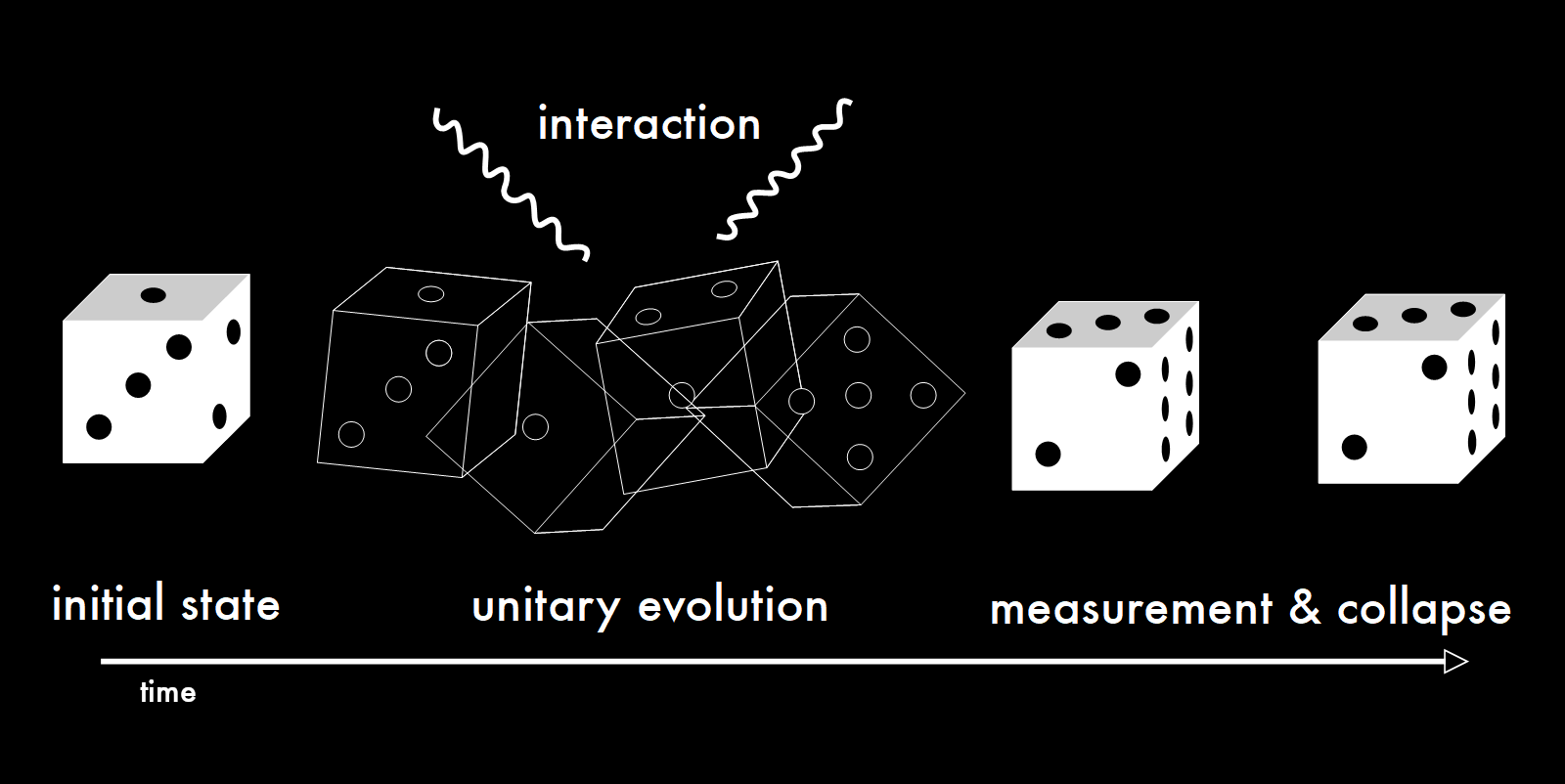
There of course comes a time in every curious person’s life when they look upon the collection of rules and mathematics comprising quantum mechanics and ask7: Why? And that’s where interpretations come in. I’ve actually become more sympathetic to the Copenhagen interpretation over the years, and it’s one of the8 … well, it’s one of them, so I’m going to start with it. I also put a picture that works both as a generic cartoon of quantum mechanics and as a cartoon of the Copenhagen interpretation.
The reason I’ve become more sympathetic to the Copenhagen interpretation (and why it works as a generic picture above) is that it just kind of takes that beginning sentence and says “Yep that’s it”. You have a wavefunction that describes everything you can possibly know about your system, and it evolves wave-like in a complex Hilbert space of configurations via the Schrodinger equation until it is observed when it instantaneously collapses9 to a single particle-like value that it keeps until something else quantum happens—and that single value is given by the Born rule10. There’s a unitary process of evolution and a non-unitary process of collapse—von Neumann’s “two processes”. To which the Copenhagen interpretation responds “Yep, that’s it.” But collapse is non-unitary. Sure. If it’s instantaneous, it means it changes faster than light. Sure does, but it’s random so can’t be used to send information. Anyway, you can see how this can easily slip into the “shut up and calculate” view where you don’t interpret the rules and the math to understand what is going on and instead just use them.
There are a large number of other interpretations of quantum mechanics because people find this state of affairs unsatisfying in some way. Some of the philosophical issues have a name like “the measurement problem” (which is a … concern? about the combination of i, iii, and iv above). It’s weird to call it a “problem” when it’s what happens; sounds like a you problem. However, I don’t think a name like that is helpful — per my roman numeral labels you can see that it covers multiple elements: is it the unitary evolution in superposition (i), the non-unitary change to a single observed state (iii), or the fact that the system continues in that state (iv)? Some people would be fine if it went back to unitary evolution after the measurement. Others don’t like the non-unitary “collapse” to a single value. As you can see one person’s resolution to “the measurement problem” could be irrelevant to another. Makes it hard to see it as a specific thing, philosophically-speaking.
I generally see interpretations fall along an axis from “I find QM unsatisfying11” to “I’m really trying to work out quantum gravity12 (QG)”. In my view (and as you can tell from my footnotes), the latter is far superior to the former. I also think an adherent13 to one of the various interpretations can fall at an independent location along that axis.
My list below isn’t going to be exhaustive of the many, many interpretations out there. Mainly I chose these to illustrate the kinds of things interpretations illuminate—or hide. I am also not going to be impartial in what follows. You can find lots of places on the internet that give other views, but this is where you’ll find mine. Especially because I’m working on my own (crackpot) interpretation.
The many-worlds interpretation
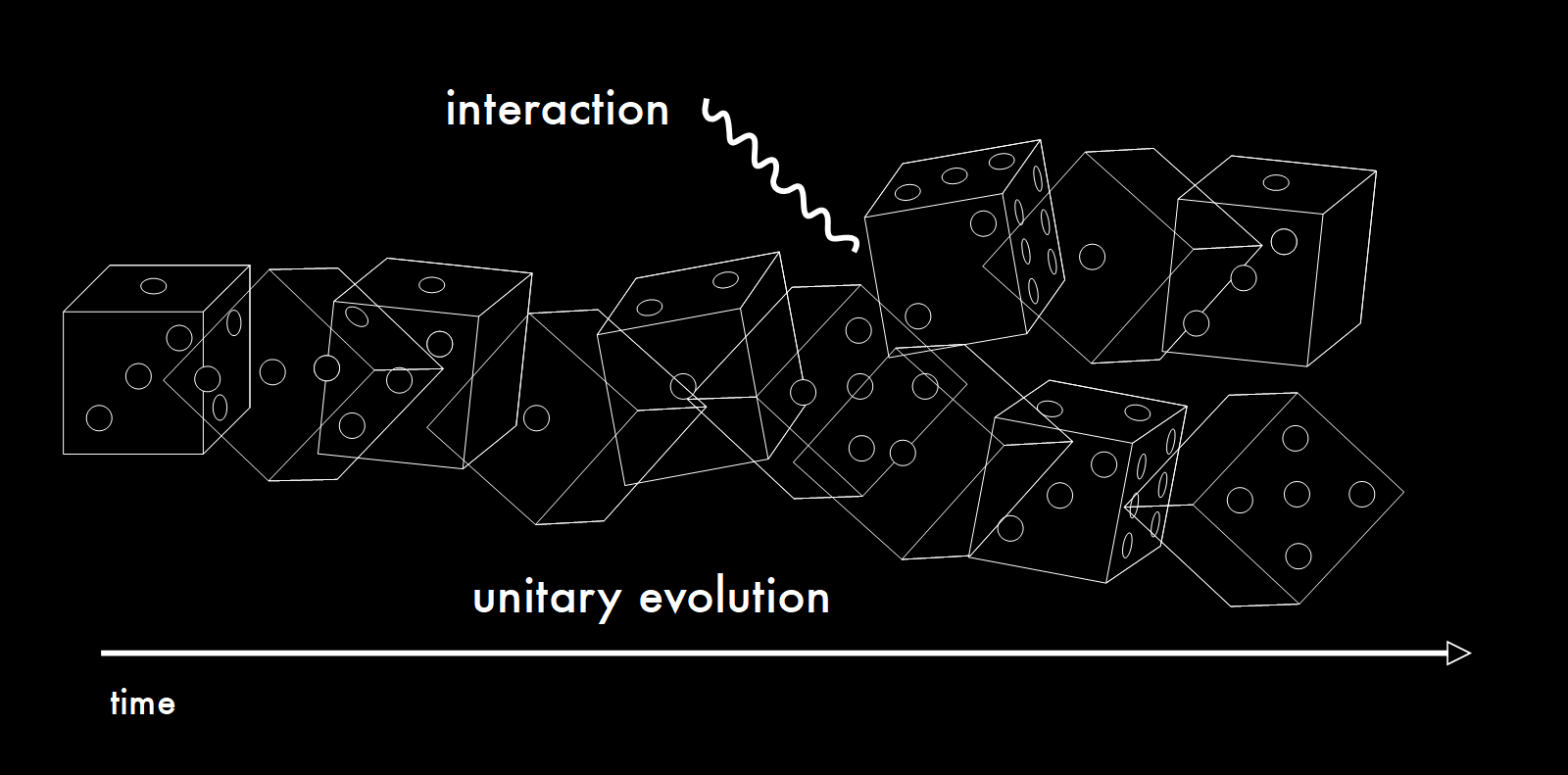
In many worlds, wavefunction collapses you!
This is my least favorite interpretation. While I don’t think it led to the proliferation of multiverses in sci fi, it didn’t help. I personally think that after he helped derive
Bryce DeWitt blinked a few times in shock … and went on tilt into nihilism—popularizing the many-worlds interpretation.
The basic idea is that the “collapse” (ii, iv) happens at the classical level where a Bayesian observer is using the Born rule as the best way to update their prior as to which universe they’re in. We’re used to time symmetric dynamics disappearing14 (see also) when we scale up from atoms to humans—this is kinda similar in an intellectually cozy way. The loss of unitary evolution is at the classical level, not the quantum level. The cost of this warm fuzzy is the creation of gazillions of other universes every second. For example, the Davisson-Germer experiment that verified electrons behave as waves during scattering shoots on the order of 10^16 electrons per second15 which would mean as many universes branching off. It’s fine if you want to treat this as a mathematical fiction16, but many worlds insists those universes are real and have energy, mass, etc. Rationalizing that, to me, is a bunch of handwaving and just-so stories. We’ve traded the “issue”17 of QM having a seemingly ad hoc combination unitary and non-unitary processes for a larger number of unobservable universes than the string theory landscape.
On the flipside, one benefit many worlds has over its competitors is that it has a natural extension to a many-particle state. It’s just the unitary evolution of that many-particle state! A bunch of other interpretations make sense for single particle states where the wavefunction can be interpreted not just as a wave in configuration space (which is what it is), but (somewhat falsely) as a wave in physical 3D space18.
When I wrote above that adherents can have an independent position on that axis, I was specifically thinking of many worlds. As an interpretation, it is very much at the “I find QM unsatisfying” end but many of the adherents today are at the “I’m just trying to figure out QG” end—the unitary evolution and collapse (decoherence) at the classical level lends itself to e.g. emergent spacetime theories.
It’s also odd to me that the “always unitary evolution” interpretation does not address the major issue—the lack of time symmetry of the collapse even if it is at the classical level. The universe just keeps adding additional universes.
Time-symmetric interpretations
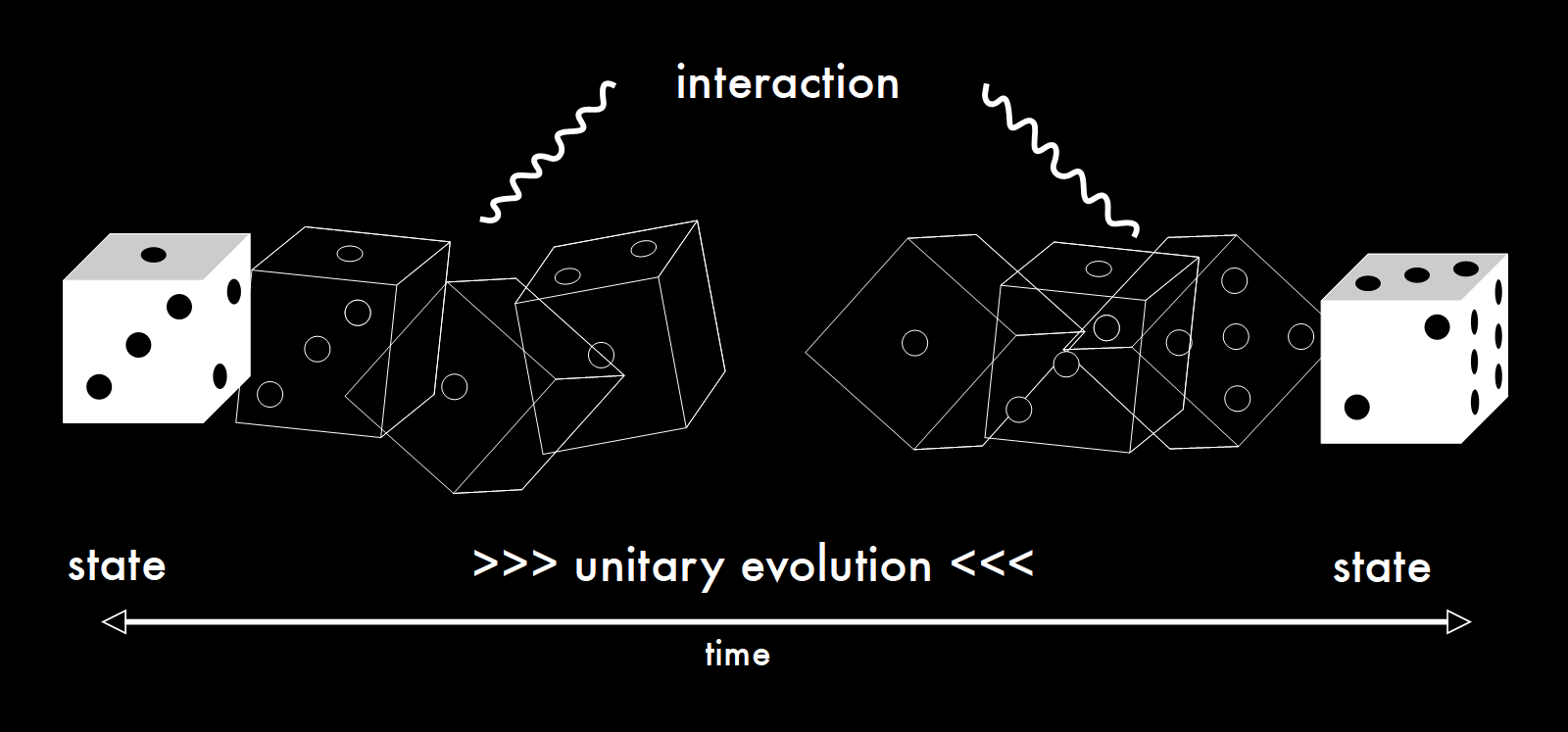
I am lumping these together19 as they often add something to QM beyond its usual mathematical instantiation—so are less interpretations and more new theories. I will shout out the two state vector formalism (TSVF; developed by giant-in-the-field Aharonov and collaborators; more a reformulation than an interpretation) and the transactional interpretation (TIQM; developed by Cramer who was a professor at UW where I went to grad school). Chose to mention these because I like TSVF but find the TIQM easier to use as an example.
Why would we want QM to be time symmetric (i.e. why would we have an issue with iv and v)? Because we fundamentally believe the microscopic dynamics are time symmetric—or more accurately CPT symmetric. If you switch matter and antimatter (C: charge conjugation), left and right20 (P: parity), and the direction of time (T) you should get the same result. This is a consequence of locality, Lorentz symmetry, and hermiticity of the Hamiltonian (the mathematical operator that preserves that unitarity through time, i.e. i above).
Now Maxwell’s equations are time symmetric, and because of that you actually get light waves (electromagnetic fields) traveling backwards (B) and forward (F) in time when you solve them. Typically you just drop the former and keep the latter. Wheeler and Feynman worked out a little trick to make it more symmetric by essentially saying:
That last bit is why it’s called “absorber” theory: it enforces that every photon launched from a charged particle is absorbed by another charged particle21. Here’s a heuristic diagram of how it works:
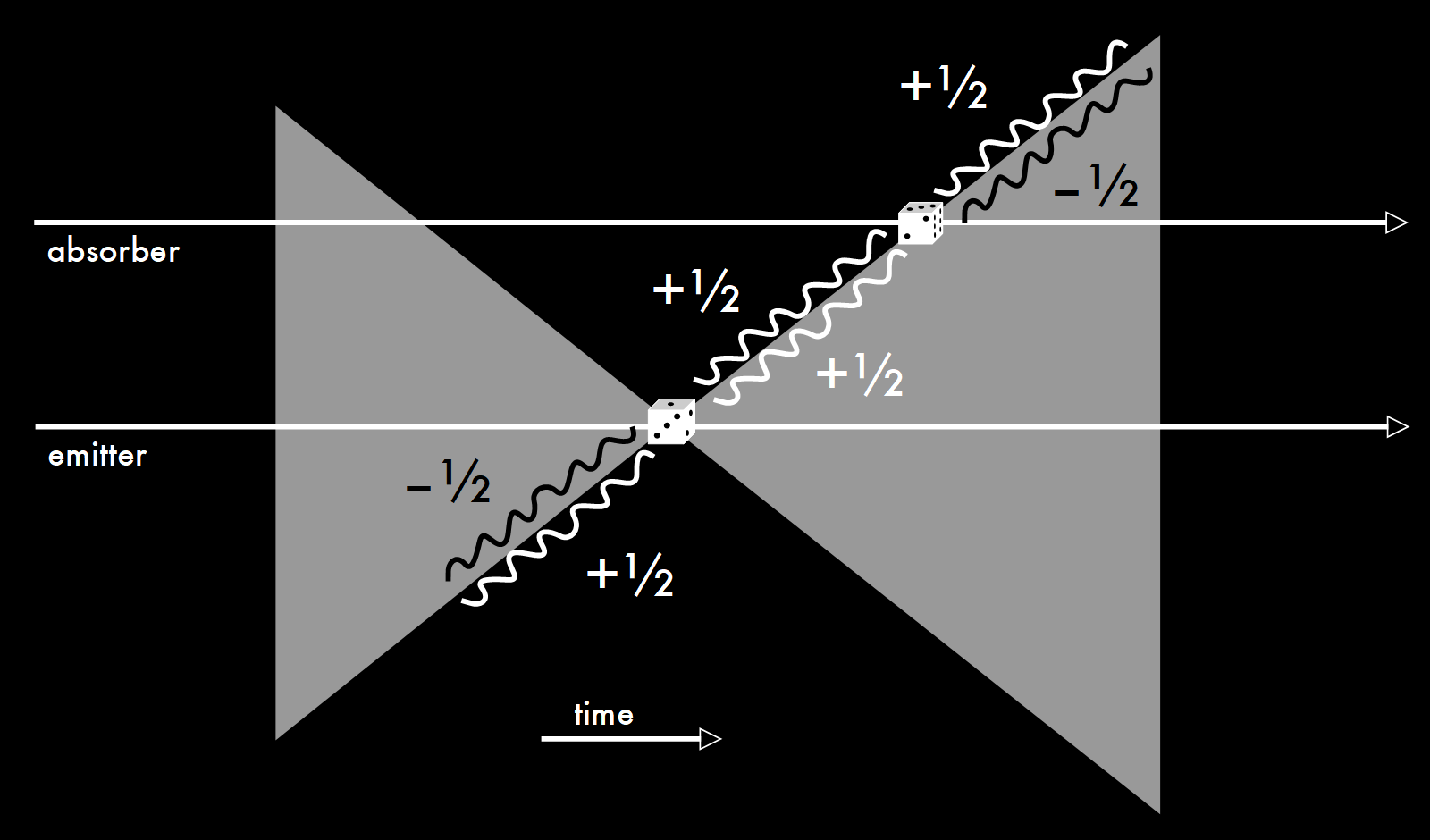
Anyway, TIQM basically uses this trick with the wavefunction so that there’s a “handshake” between the initial state and the final measured state that makes it time symmetric (you can just swap the labels “initial” and “final” on the states). There might be an issue with how the TIQM handles Wheeler’s delayed choice thought experiment22—and it would make sense that it would because you’re changing “the handshake” at some random point during the propagation. However I have not dug too deeply into this so it may be settled one way or another. Or not? Regardless, there is one interpretation that is completely hosed23 (IMO) by the delayed choice experiment …
Pilot waves
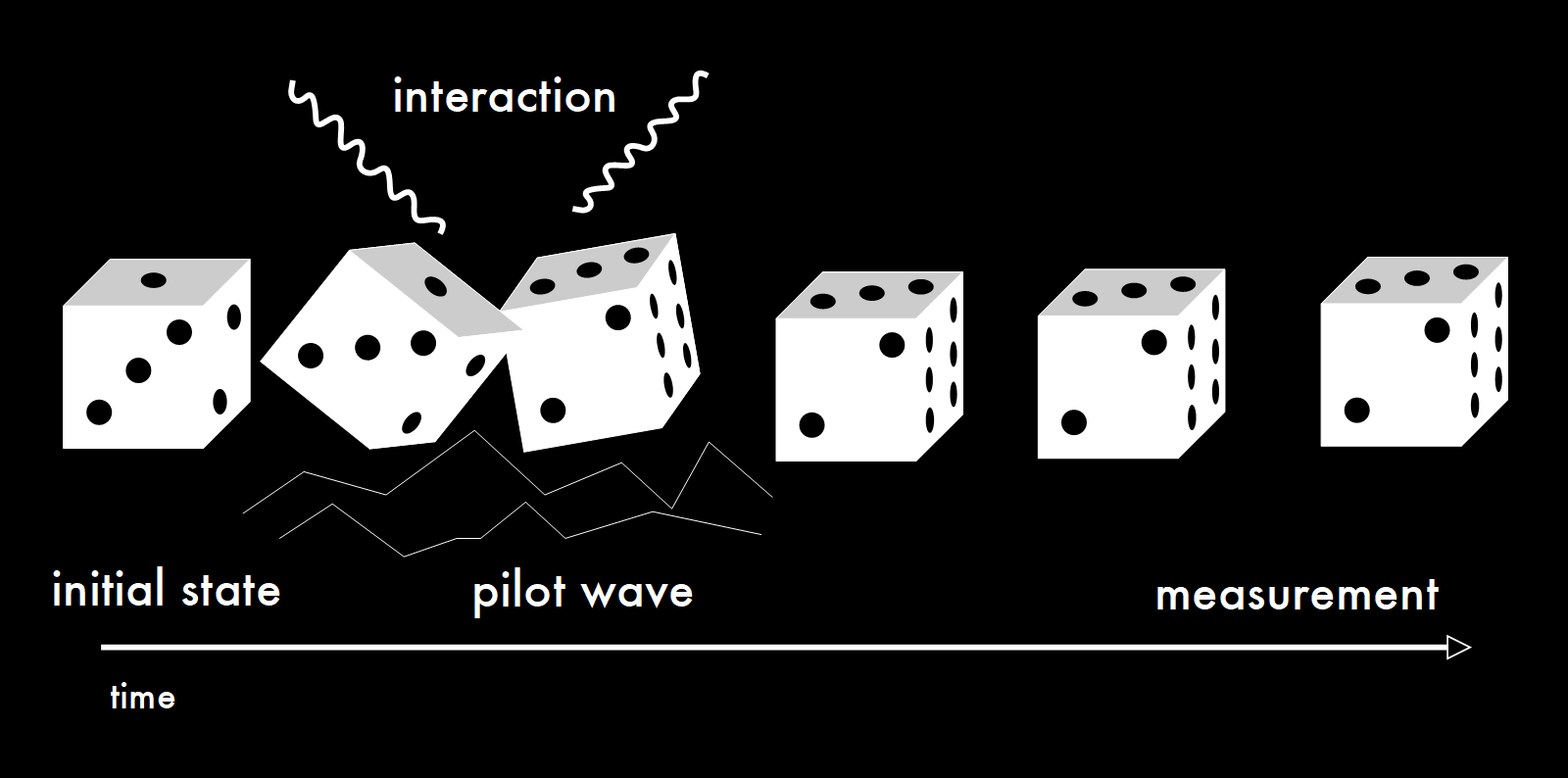
I feel like people add “de Broglie” to this purely as advertising to non-physicists unfamiliar with Bohm. Like if I’d started calling my own crackpot interpretation (coming up below!) Bousso-Smith theory because I was inspired by some musings Bousso put in a paper twenty years ago. There are two pieces to this interpretation: 1) rewriting the math of QM in a completely equivalent way (i.e. being ok with i), and 2) making claims about what that math means that often seem to conflict with what happens in experiments (objecting to ii, iii, iv, and v). Plus the way you have to handle 1 & 2 are infinitely more work—the math is nigh impossible to solve except in extremely simple cases, and the contortions you have to go through to resolve the conflicts with experiments adds 1000s of words24 to a given description. The net effect is embodied by this meme:
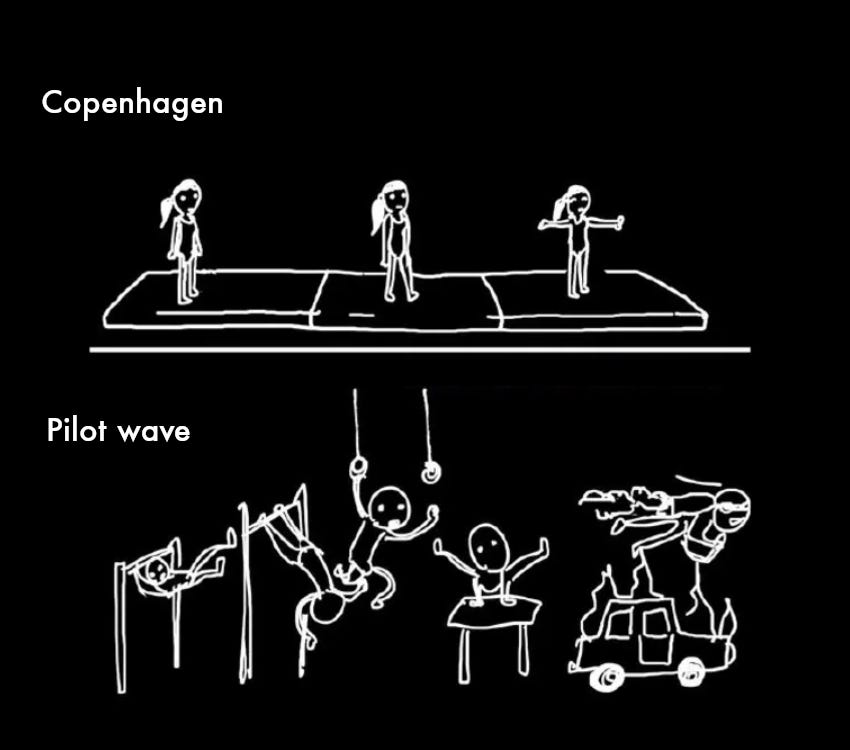
The interpretation essentially organizes the equations to look like classical mechanics —but there’s a “quantum potential” that brings in all the quantum stuff. It’s equivalent to the Schrodinger equation—just harder to solve. It purports to give you back definite particles following classical trajectories … at the cost of locality and completeness. You could imagine that “quantum potential” as essentially a “spooky action25 at a distance potential”. All of the trajectories exist simultaneously across space and the randomness comes from not knowing which one the particle is on (i.e. the wavefunction yielding that potential is “incomplete” in terms of its knowledge of the state of the system). In addition, it suffers greatly when you go beyond a single particle state26.
While I think this interpretation is hot garbage if you want to do quantum mechanics, I do think it could have utility in a search for quantum gravity. If an electron followed one of Bohm’s trajectories, classically, it would radiate because there are accelerations. But it doesn’t. However, you know where else an electron subject to an acceleration doesn’t radiate? A gravitational field. Now this is pure speculation but if GR = QM (a big if), Bohmian trajectories could be a tool in illuminating how QM interacts with diffeomorphism invariance27.
Let’s step it up a notch and look at an interpretation where it appears (to me) to be literally impossible to do any calculations and trade spatial non-locality for temporal non-locality.
Indivisible stochastic processes
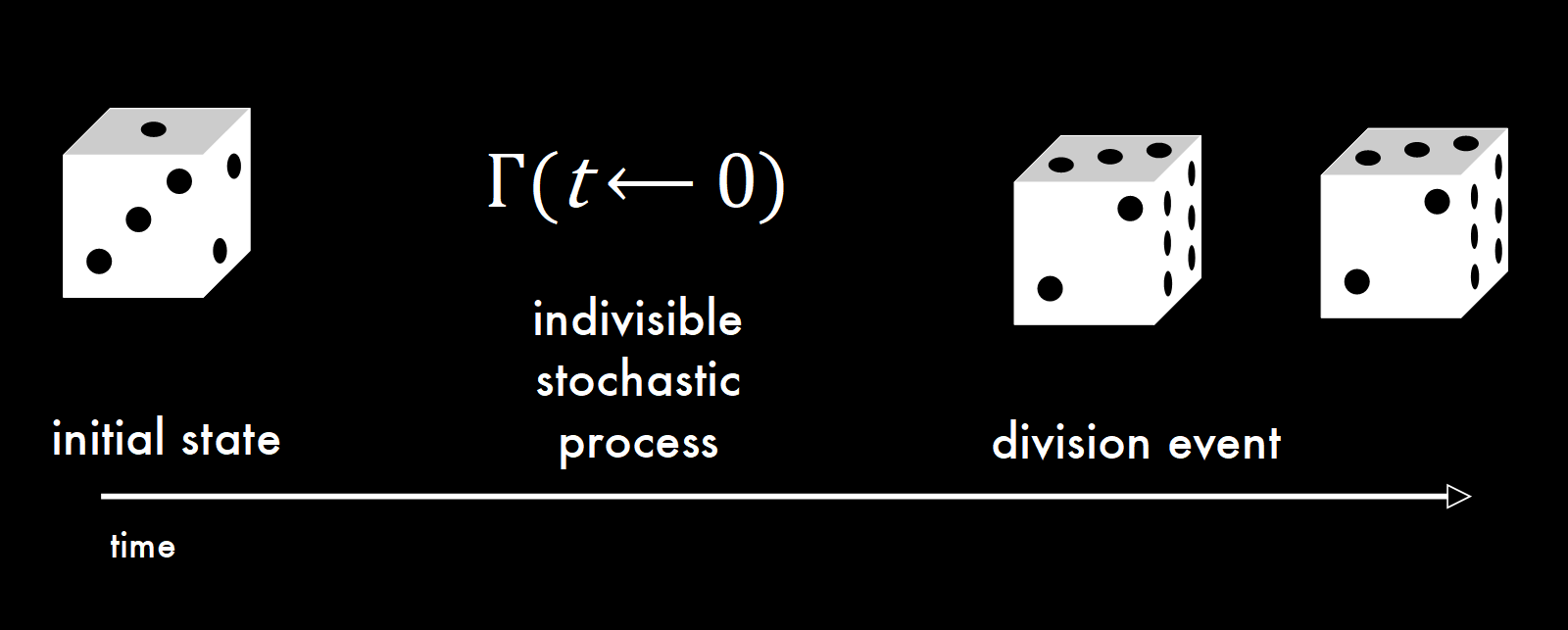
Barandes’ Indivisible Stochastic Processes (ISP28) is the newest interpretation having come out only a couple of years ago. I put it on this list because I hope I’m making my point clear that the utility of interpretations of quantum mechanics is in how they help you think about fundamental physics—not for how you work with quantum mechanics. I have no idea even in principle how you would go about using this formalism to calculate the energy levels of Hydrogen—except to say the it appears to allow something that looks like Heisenberg picture QM to exist consistent with the Copenhagen interpretation. If you did have to calculate the energy levels of Hydrogen you’d start with some words about ISP, go on to talk about how the Heisenberg and Schrodinger picture are equivalent … and then just use the Schrodinger equation.
The most widely used stochastic process in mathematical modeling is the Markov process. I talk a bit about Markov processes in relation to some fundamental philosophical questions in a post from a couple months ago. There are some assumptions in a Markov process that Barandes’ relaxes to make a general kind of abstract non-Markovian (but still real-valued contra ii) stochastic process being called an indivisible process. The name makes sense. While for a divisible process (D), you can in principle take the transition matrix29 and “divide” it at a time t′:
you can’t do this for an indivisible process (I):
If you try by creating “a quasi-divisible process” (Q) then you are forced to use complex numbers30 and get:
These “other terms” seem like they could be quantum mechanical interference terms. Using the roman numeral items from the beginning of the post, Barandes is objecting that i & ii are not the “real” story, but you can get to i & ii if you want to represent the “real” indivisible story as a divisible one. Again, Barandes’ ISP formulation appears to allow something that looks like QM—it does not appear (to me) to truly derive QM.
However, it does give an interesting new perspective. It’s still just a random process, so doesn’t “explain” the randomness of QM. But then the Schrodinger equation is essentially a random process (diffusion) equation in imaginary time. And, in a … pun?, you can think of the time between the division events at 0 and t as “imaginary”—exactly as Wheeler’s delayed choice thought experiment (above) says: there are no definite states at times t′ between the initial state at 0 and when you measure it at t. If you try to invent them, you get quantum mechanics (or at least some kind of similar weirdness).
In General Relativity (GR) there’s more than just that time-reversal symmetry I talked about above—there’s diffeomorphism invariance of your manifold M, labeled Diff(M). One of the things Diff(M) doesn’t get along with is a preferred foliation of M over time (i.e. what’s required for unitary evolution for each of those interim times t′)—but it does preserve coincidences of worldlines (i.e. the the spacetime location of both the experimental preparation apparatus and the state at time 0 and spacetime location of both the experimental measurement apparatus and the state at time t). There’s a conflict between the unitary evolution in QM and Diff(M) in GR—and when you try to put them together you get the Wheeler-DeWitt equation above where time drops out. I think the ISP might well give insight into what is called more generally the “problem of time” in QG by allowing time re-parameterization between 0 and t instead of forcing a foliation t′ needed for QM.
One of the reasons I like this interpretation is that the idea of not knowing what happens at each time t′ between 0 and t (or suitable redefinition to t₁ and t₂) is a key part of my own idée fixe.
Elsewhere (warning: incomplete crackpot physics)
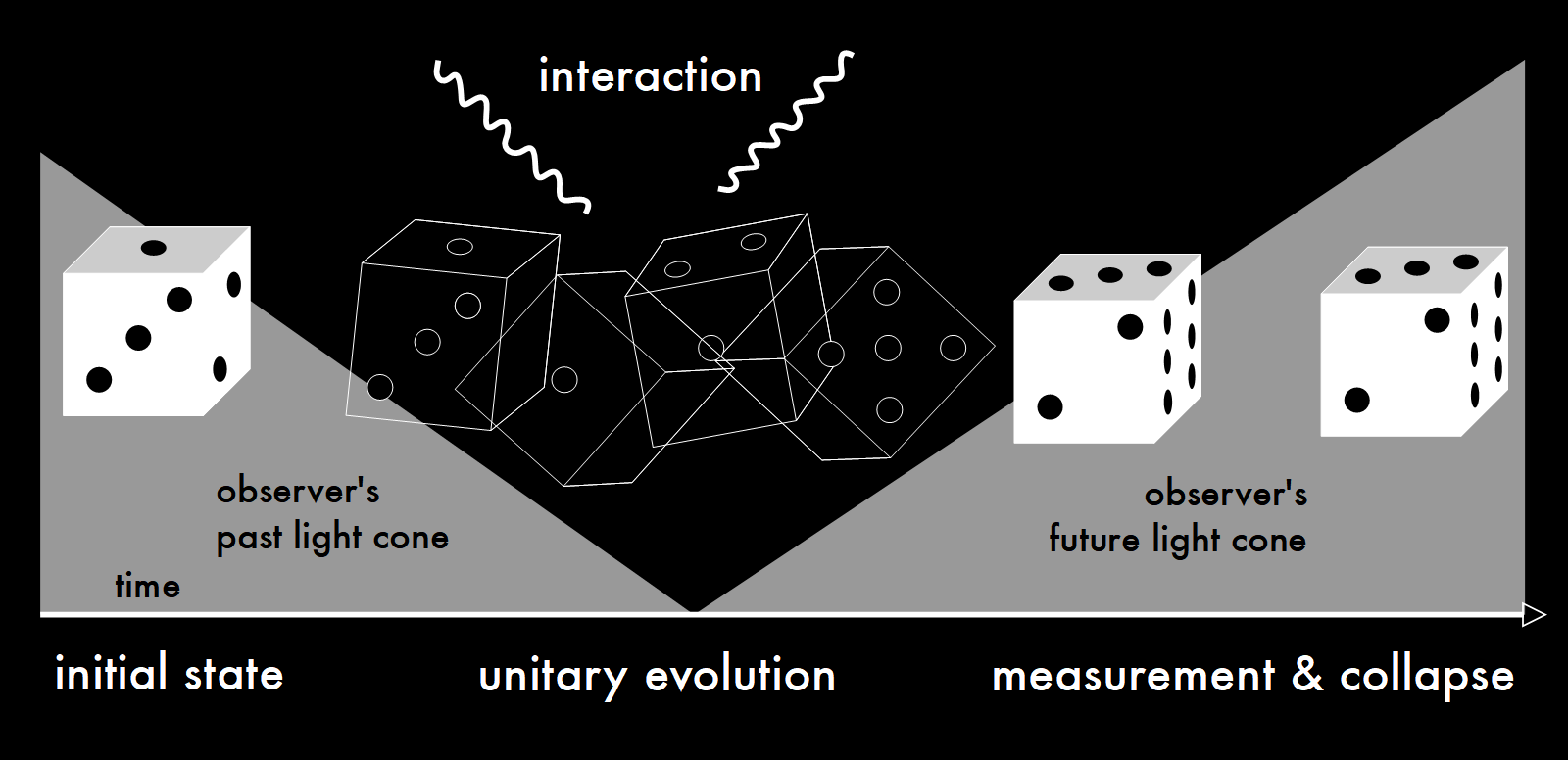
I went into detail about the motivation of my “elsewhere” interpretation of QM in the previous post. It’s nowhere near as complete as even the most recent of the interpretations above—in fact, I would say it has a negative age. But given I don’t know what’s in my future light cone, I can’t give it a definite number.
Another thing we don’t know about is what is happening “elsewhere”—the region of spacetime outside of an observer’s light cone. Normally in classical special relativity (SR) you would say: “Sure, there was a particle that left my past light cone with a given position and momentum (up to Lorentz transformations), but I know exactly with what position and momentum (up to Lorentz transformations) I will see it when it comes back into causal contact in my future light cone.” The elsewhere interpretation says that is a fiction that only makes sense in the classical limit. You cannot in principle know what series of events occurred (even spooky action!) because the system was not in causal contact with an observer—you only know e.g. conservation laws31. That lack of knowledge of what happens elsewhere in SR is (hypothesized to be) exactly the same as the “incompleteness” (quantum randomness) of the wavefunction in QM—i.e. “SR = QM”. The unitary evolution and the complex wavefunctions in i & ii is just how you’re supposed to evolve states that leave each other’s light cones because you can’t say for sure what is going on—and QM is just the most general way to do that.
For a short instant, say, the Planck time, every particle in the universe is outside the light cone of every other—so everything undergoes a short bit of quantum evolution. Our classical picture emerges when the interactions in the environment interrupt the unitary evolution often enough that a picture similar to wavefunction collapse / many worlds decoherence a the classical level emerges. The non-unitary piece comes as the system re-enters the observer’s light cone; barring any other quantum effects it basically remains in the observer’s light cone. Quantum measurements are essentially where an experiment (or nature) creates a “bubble32 of elsewhere” in that environment that makes the unitary evolution the only thing we can know about the system. That bubble can potentially be as large as technology allows33. Right now we can only get a hundred or so spin states to hang around elsewhere (per this proposed interpretation) on the order of milliseconds—or 16 micrograms of a crystal.
The thing is that this “interpretation” doesn’t currently have any mathematics behind it aside from “use quantum field theory”. I haven’t even proved that every quantum effect can always be interpreted as a quantum system being “elsewhere” from the measurement system—so it’s not yet clear this even is an interpretation.
However, my aim isn’t really to develop a new interpretation of QM to do QM calculations or even understand “what’s really going on34” though. It’s better thought of as my intuition into the problem of the incompatibility between QM and GR. If QM drops out of SR with only minimal changes to either, then maybe that will lead to understanding how QM fits with GR?
In the end, who really knows how QG will work out? I don’t. The ultimate inspiration might be “QBism”35. Not only is this why I am interested in interpretations of quantum mechanics, I think it’s why most physicists who work on interpretations are interested36. This is just my gut feel, but I don’t think a “theoretically intuitive and intellectually satisfying” interpretation of QM will ever exist without some major theoretical and/or empirical breakthrough in understanding some aspect of the standard model. It could be just in quantum field theory alone. It could be QG. It could come from quantum cosmology.
But here, today—as of the end of 2025—the world looks like the Copenhagen interpretation: complete information in the wavefunctions, unitary evolution, and nonlocal collapse in measurements.
“Probability preserving” or “information preserving”
The complex numbers always seem to be necessary, but the wavefunctions do not. There are different “pictures” associated with seeing wavefunctions evolving in time (Schrodinger picture) and matrix operators evolving in time (Heisenberg picture) that roughly correspond to Schrodinger’s wavefunction and Heisenberg’s matrix formulations of quantum mechanics. I’m going to stick to interpretations and not go into formulations (the mathematical representation of essentially the same underly “physics”). I’ll just note this as they come up.
There have been no experiments contradicting quantum mechanics.
Points in spacetime “far” enough apart (proper time) that a beam of light could not have bridged the gap between them.
I’m pretty sure I got the big ones including the measurement problem (measurements appear to do something to the system), the completeness of the wavefunction (as far as we know, i.e. no “hidden variables”), and Bell’s nonlocality requirement.
This is a lot of what “interpretations” tend to be—translating math into a description of what is physically happening (i.e. “the physics”). Sometimes interpretations add extra math that is also translated into descriptions.
Actually a more common response is not a question but a statement: That doesn’t make sense.
I’m not going to get into history of the interpretations or how widely they are believed, used, or taught. The Copenhagen interpretation can be argued to maximize most of those traits—or at least more so than any of the other interpretations.
Imagine you have a normal distribution at one time, then you measure it and it becomes a Dirac delta function at the result you got. This part is “non-unitary”. I personally think it is fundamental to probability.
The Born rule is in a kind of quantum superposition of being considered “the mathematics of quantum mechanics” and “an interpretation of quantum mechanics”—you “interpret” the absolute square of the wavefunction as a probability distribution. Some interpretations try to derive this.
“Yes, a uh, a profound sense of fatigue... a feeling of emptiness followed. Luckily I... I was able to interpret these feelings correctly. Loss of essence.”
For a variety of reasons, including the fact that the unitary evolution requires a preferred foliation of time, quantum mechanics and general relativity (GR) do not appear to be compatible. It is possible this is a formulation issue or an interpretation issue. Or it is possible that a different formulation or interpretation could provide intuition into a resolution. However, I also generally use the term “quantum gravity” to mean some advancement beyond the present status quo in physics of the standard model + GR.
When I say “adherents” I don’t mean to say all physicists have chosen a camp—or even if they have—one camp only. The typical physicist probably doesn’t think about what interpretation they adhere to that often. I don’t think I thought about it the entire time I was in grad school except when I looked at the back of Sakurai at the supplement on non-exponential decays. And when I have thought about it, I tend to use whichever one is most helpful to what I’m trying to understand. And I didn’t try to come up with my own because I had a problem with the existing ones—I thought, per the thesis of this post, it might help figure out new things.
I personally think this is a consequence of using probability, an inherently time-asymmetric concept. I do not think using probability to talk about something in the past is technically the same thing. Sure, to a good approximation they might be the same thing. But a probability of something that may or may not have already happened is not the same as the probability of something yet to happen. Fight me.
This is probably the right order of magnitude estimated from a vacuum tube current of 1 mA = 0.001 C/s = 0.001/e #/s ~ 10^16 #/s (number of electrons per second; e is the electron charge). Depending on the power / luminosity it could be much larger or smaller than this though.
The path integral technically includes that frequently mentioned path “to the moon and back” in whatever calculation is being done to illustrate the concept but that is a mathematical fiction—you can generally find a way to achieve the same result without such nonsense.
Remember—this is just how QM works. The “issue” is not empirical, but rather in our heads.
It takes 7 dimensions to describe the 2-particle wavefunction: 3 spatial particle A coordinates + 3 spatial particle B coordinates + 1 time. No one is going to ever going to be able to draw that in an intuitive way.
Yes, I know—forward and backward and up and down as well. All three spatial axes.
It does mean that no photon ever ends up at null infinity (ℐ ⁺); since no matter can reach ℐ ⁺ either, the only thing there would be gravitons (in this theoretical picture). If you try the abosrber theory trick with gravity, it doesn’t work—which would create an interesting theoretical puzzle of why massless gravitons get to go to ℐ ⁺ but not massless photons. Putting a pin in this one in light of this and this. The obvious resolution is that absorber theory is not correct at scales ~ size of the universe for some reason.
This is the third reference to Wheeler in just a few paragraphs! He’d retired from UT like a decade before I got there so I never met him—but his name was still up on the directory in the physics department. Did meet Cecile DeWitt though.
Just check out the total word salad on wikipedia. Basically they say the part that Bohmian trajectories were supposed to be helping you understand change in such a way that if you’d just “shut up and calculated” in the first place you would have gotten the delayed choice result right all along. True this is my opinion—but seriously can a Bohmian please explain it without the word salad?
The Feynman Lectures Vol III cover in ~60 pages essentially everything The Undivided Universe does in ~400. (Bohm & Hiley’s book has some great 80s/early90s diagrams and seeing at the link my nearly mint condition hardcover copy I bought for like $5 in a used book store in Austin a couple years after it came out would be ~$200 new.)
I generally have no problem with this given I’ve proposed a “spooky action” (the integral of a “spooky Lagrangian” with “spooky kinetic and potential” terms).
I mean the Hamilton-Jacobi formalism easily handles multiparticle states—in part what it was designed to do. It’s just doesn’t do so in an intuitive way that the pilot wave theory is trying to go for. In my view that defeats the purpose of the interpretation.
One of the interesting aspects is that Bohmian trajectories don’t intersect. Einstein’s resolution of the “hole argument” was that general covariance preserved coincidences in world lines. Therefore a diffeomorphism could change a collection of pilot wave trajectories into literally anything—even classical paths. Also—the quantum potential is a measure of the curvature of the wavefunction. At this point I’m just riffing, but I would definitely listen to someone taking pilot waves seriously as a path to QG. I just think it’s a useless interpretation for doing QM qua QM.
This is my label for the interpretation. It’s relatively new so I don’t think it has a formal name yet.
The arrows go left. I mean I’m drawing spacetime diagrams with time going right instead of up. What direction does time go for you? Into the page?
Or e.g. a Clifford algebra that accomplishes the same goal.
There’s a lot more to this in the sense that quantum field theory is fundamentally just a way to propagate information you know about a state at one time to another time in the most general way possible consistent with some basic ingredients (e.g. conservation laws i.e. symmetry).
This “bubble” can be specific to particular measurements—or another way, the light cones involved in the measurement can be specific to certain quantum numbers. You can send polarization-entangled photons down fiber optic cable that represent a bubble of elsewhere for polarization but not e.g. momentum which could be “measured” (i.e. bent in a path as the fiber optic cable turns around). Noise in the system is basically what ruins any quantum state / measurement—i.e. something with the right quantum numbers creating an extraneous light cone that pops the bubble of elsewhere.
My (draft) short story Wigner and I asks what if you could make a bubble of elsewhere (compared to the rest of the universe) big enough for a person (but also adds a bit where consciousness is necessary for wavefunction collapse). It’s not meant to be “scientifically accurate” though.
Our descriptions will always be a model. Sorry.
Ha ha lol no it won’t. Unless it’s like some student trying to understand QBism stumbles upon something completely different that ends up being quantum gravity.
I should clarify that I totally think philosophers (of physics, or not) should think about interpretations qua interpretations—and question whether the explanations are satisfying. Physicists are not trained in the philosophy that touches on their discipline very well if at all.